
You have an idea for an AI project. Maybe it's a support assistant that answers questions from your own documents, or an agent that takes over a slow manual workflow. Then you ask the obvious question: what will it cost?
Most people who try to get a quote for AI development hit the same wall. Quotes arrive with a single number and no explanation, or they come back so vague that no one can tell what's included. Two companies quote the same idea at wildly different figures, and neither can say why.
That usually happens because AI projects can't be priced from a one-line description. The price depends on your data, your systems, the model approach, and what "finished" actually means for your business.
At 4xCode, a UK-based team building custom AI applications, chatbots, AI agents, generative AI and LLM solutions, machine learning models and AI integrations, we start with scope and put the number second. Send us a short project brief and we'll come back with a scoped estimate, a proposed timeline and a plain-English explanation of what's driving each part of the cost.
The short version: a reliable AI development quote depends on four things: the scope of work, the readiness of your data, the systems you need to connect, and the model approach. This page explains each one so you can brief us well and compare any quote you receive.
Request Your AI Development Quote using the project form on this page. A rough idea is enough to begin.
How Do You Get an Accurate Quote for AI Development?
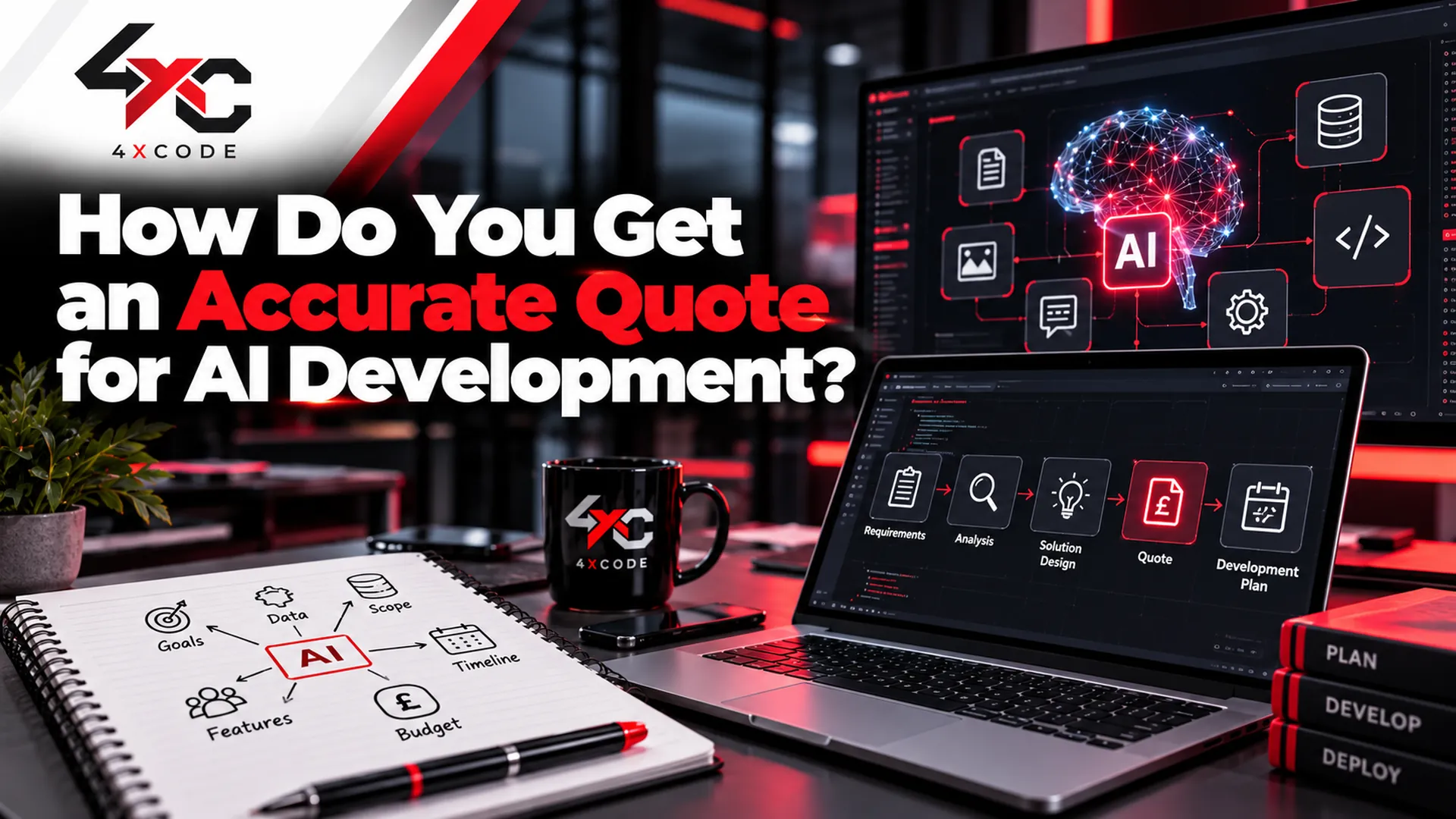
An accurate AI development quote comes from three things: a clear project brief, a feasibility review of your data and existing software, and an agreed scope of work. Skip any of the three and the estimate becomes a guess that moves later.
That's why the most common problems with AI quotes aren't about money. They're about missing information. Incomplete project details, unclear success criteria and mismatched expectations between the client and the development team cause most budget drift. A good quotation process is designed to catch these early, before anyone commits to a development agreement.
Before you send a brief, it helps to be able to answer these questions:
- What business problem are you solving? For example, reducing manual document handling or answering repetitive customer questions faster.
- Who will use it? Customers, internal staff, or both.
- What data exists today? Documents, databases, tickets, call transcripts or product records.
- Which systems must it connect to? A CRM, helpdesk, ERP, website or internal APIs.
- What are your security and privacy requirements? Sensitive data, access controls or industry rules.
- What's your budget range and target launch date? Even a rough range helps us recommend the right approach.
You don't need every answer. Any gaps become the first job of a discovery conversation.
What Information Do You Need to Request an AI Development Quote?
Less than most people think. A good starting brief fits in a few paragraphs and covers the goal, the users, the data and the systems involved.
Here's what we find most useful, and why each item matters:
- A plain description of the outcome. "Cut the time our team spends answering policy questions" is far more useful than "build a chatbot." The outcome tells us whether you need a chatbot at all.
- Examples of the data involved. A sample of the documents, records or messages the solution will work with. Data quality and structure change the amount of preparation work, and that changes the cost.
- A list of existing tools and APIs. The more systems the solution needs to talk to, the more integration work sits inside the quote.
- Any constraints. Hosting location, compliance requirements, a fixed launch date or a hard budget ceiling.
If your idea is still early-stage, send what you have. A proof of concept is often the right first step, and discovery fills in what's missing. In some cases we may ask to review your existing software or data before giving a firm estimate. That's normal, and it protects you from a number that falls apart later.
Not sure what to include? Send what you have and we'll help you shape the brief.
What Happens After You Submit Your AI Project Brief?
You'll know what happens next, because we lay it out in six stages:
- Submit your project requirements. You send the brief through the form or by email.
- We review your business goals and technical needs. A project specialist reads your brief and notes the questions it raises.
- We assess feasibility and scope. We check whether the idea is technically realistic with your data, and we define what's in and out of scope.
- We prepare your cost estimate and timeline. You receive a breakdown rather than a single number, with the assumptions behind it.
- We review the proposal together and agree on deliverables. This is where scope, milestones and acceptance criteria are confirmed.
- We plan the development kickoff. Once you're happy, we agree on the schedule, the team and the first milestone.
We'll confirm timelines for each stage after reviewing your brief, because a simple chatbot proposal and an enterprise integration proposal don't take the same time to scope. We'd rather give you an honest timeline than a promise we can't keep.
How Much Does AI Development Cost, and What Affects Your Quote?

There's no single price for AI development, and any company that quotes one without seeing your brief is guessing. A knowledge-base chatbot built on your help articles and a multi-system AI agent that reads emails, updates your CRM and triggers workflows are different projects, with different effort, risk and running costs.
What we can do is show you exactly which factors move the number, so the quote you receive makes sense and you can compare it fairly.
Cost factor | Why it affects the price | What to prepare |
| Project scope and feature complexity | More features, user roles and workflows mean more design, build and testing time | A prioritised feature list |
| Model selection and customisation | Using an existing large language model through an API differs from fine-tuning a model or training a custom machine learning model | Your accuracy and privacy expectations |
| Data preparation and data quality | Messy, scattered or inconsistent data needs cleaning, structuring and sometimes labelling before it's useful | Samples of your real data |
| Integrations and third-party APIs | Each connected system adds build, testing and ongoing maintenance work | A list of tools, with API access details if available |
| Cloud infrastructure and deployment | Hosting on AWS, Google Cloud or Microsoft Azure, or on private infrastructure, shapes setup effort and running costs | Any hosting or data-location requirements |
| Testing, security and compliance | Model evaluation, security testing and compliance checks add effort, especially with sensitive data | Your security policies and compliance needs |
| Ongoing maintenance and support | Monitoring, updates and improvements continue after launch | Your expectations for post-launch support |
Two of these are worth a closer look because they cause the most surprises.
Data readiness. The model gets the attention, but data preparation often takes the largest share of effort. If your documents are out of date, duplicated or locked in formats that are hard to read, expect that work to appear in the estimate.
Running costs. Development fees are only part of the picture. Solutions built on model providers such as OpenAI or Anthropic, or on a cloud platform, carry recurring charges for usage, hosting and monitoring. Token usage grows with your traffic, and inference costs scale with it. A trustworthy quote shows development fees and recurring third-party costs separately, so you can budget for both.
An illustrative example, with assumptions. The following is not a price. It shows how an estimate is itemised for a hypothetical project: a document-based support assistant for a small business. A well-structured quote would list:
- Discovery and scoping, including a review of the source documents
- Data preparation, including cleaning and indexing the documents into a vector database
- Assistant build, using retrieval-augmented generation (RAG) so answers draw from your own content
- Integration with the helpdesk or website where the assistant will live
- Testing and model evaluation against a set of real questions
- Deployment and handover
- A separate line for monthly model usage and hosting
- A separate line for optional maintenance and support
If you've been handed a quote that lumps all of this into one figure, ask for it to be itemised. You're entitled to know where the money goes.
Fixed-Price, Hourly or Dedicated Team: Which AI Pricing Model Suits Your Project?
The right pricing model depends on how well-defined your project is. A fixed scope suits a different model than a product that will keep evolving.
Model | Best for | Main advantage | Main limitation |
| Fixed-price | Projects with a clearly defined scope and deliverables | Budget certainty | Changes to scope need a formal change request |
| Hourly (time-and-materials) | Projects where requirements will evolve | Flexibility to adapt as you learn | Final cost is less predictable |
| Dedicated team | Long-term roadmaps with continuous development | Consistent expertise and fast iteration | Higher ongoing commitment |
| Proof of concept or MVP | Validating an idea before a full build | Lower initial investment, early evidence | Not a finished production system |
| Maintenance retainer | Live systems that need monitoring and updates | Predictable support costs | Ongoing monthly commitment |
If you're unsure, a proof of concept is often the safest route. It tests technical feasibility with your real data before you commit to a full build, and it gives you evidence to take to stakeholders. An MVP then delivers a limited but usable product, and production readiness comes after that. We'll recommend the model that fits your brief rather than the one that's easiest for us to sell. We'll confirm which engagement models apply to your project when we review it.
Want a clearer picture of your own numbers? Get a Project Cost Breakdown for your AI idea by sending us your brief.
What Is Included in Your AI Development Proposal, and What Is Excluded?
A proposal should tell you exactly what you're buying. When we prepare one, you can expect it to set out:
- Scope and deliverables: what will be built, in plain language.
- Milestones and timeline: the stages of delivery and when you'll see progress.
- Estimated costs: itemised, not bundled.
- Technical assumptions and dependencies: for example, that you'll provide API access, or that the source data is available by a certain date.
- Testing and acceptance criteria: how we'll measure whether the solution works, including model accuracy and performance against agreed examples.
- Deployment and handover: how the solution goes live and what documentation you receive.
- Post-launch support options: what ongoing maintenance looks like and what it costs.
Just as important is what the proposal excludes. Third-party fees such as model usage, cloud hosting and licences for external tools usually sit outside the development fee, and a good proposal says so clearly.
Scope changes will happen on many projects. When they do, a change request explains how the new requirement affects the timeline and the cost before any extra work begins. That keeps surprises off your invoice.
Why Request Your AI Development Quote from 4xCode?
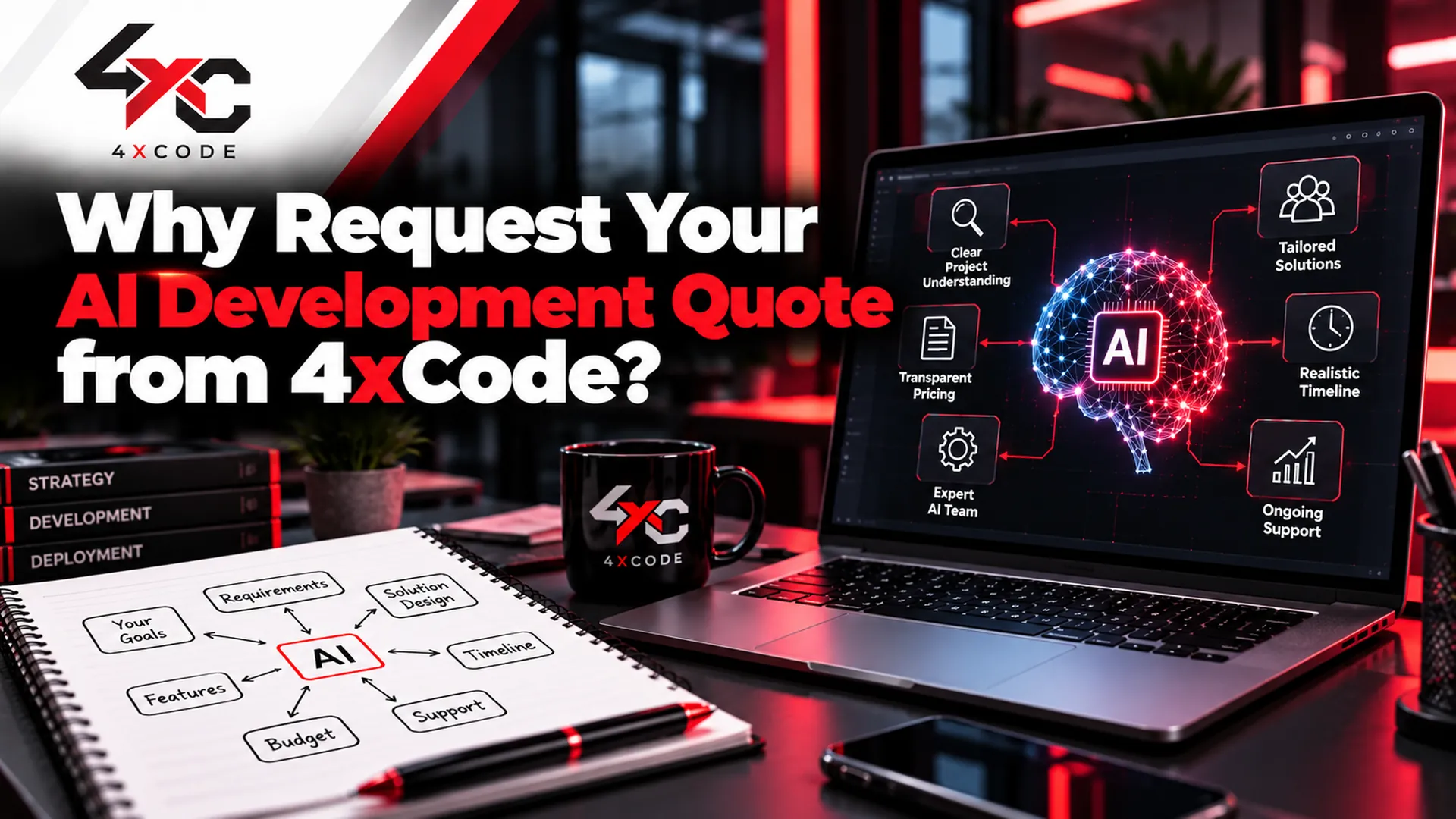
Because we start from your business problem, not from a technology we want to sell. Sometimes the right answer is a custom build. Sometimes it's a smaller piece of work, or an off-the-shelf tool that already does the job. We'd rather tell you that in the first conversation than after you've spent your budget.
Here's what we can quote:
- Custom AI application development: AI-powered software built around your workflow.
- AI chatbot and virtual assistant development: assistants that answer questions from your documents, support customers or help your team.
- AI agent and workflow automation: agents that carry out defined tasks across your tools.
- Generative AI and LLM application development: including document search, content tools and knowledge-base assistants.
- Machine learning and predictive analytics: forecasting, anomaly detection and recommendation models.
- AI integration with existing software: connecting AI capabilities to your CRM, website, helpdesk or internal systems.
We build with established tools and platforms such as Python, TensorFlow and PyTorch, and we work with model providers and cloud platforms including OpenAI, Anthropic, Google Cloud, Microsoft Azure and AWS. We recommend what suits your requirements, not what we happen to prefer.
Who this works for:
- Startups validating an idea with a proof of concept or MVP before raising or spending more.
- Small and medium-sized businesses that want to reduce manual workload and speed up routine processes.
- Enterprise teams integrating AI into existing systems while meeting security, procurement and compliance requirements.
A typical scenario. Picture an operations manager whose team spends hours each week searching internal policy documents to answer staff questions. They don't know whether they need a chatbot, a search tool or something larger. A good first conversation separates those options: we review a sample of the documents, check how the questions arrive, and recommend a small proof of concept built around retrieval from the existing content. The quote then covers that first phase, with a clear view of what a full rollout would involve.
Is an AI Development Quote Free, and Who Owns the Software We Build?
Two fair questions, and you should get straight answers before you share anything sensitive.
On cost: we'll tell you at the start if any part of the scoping needs dedicated discovery work, and we'll explain what it covers before you commit to anything. You shouldn't have to wonder what you're agreeing to.
On ownership: intellectual property, source code ownership and confidentiality should be written into the development agreement, not left to assumption. We're happy to sign a non-disclosure agreement before you share your brief or data. We'll set out how your data is handled, who has access to it and how it's protected, and we'll confirm ownership terms in the proposal before any work begins.
You can also start small. If you'd rather test the idea first, a pilot or proof of concept lets you validate the approach before investing in a full build.
Ready to move forward? Request Your AI Development Quote through the form on this page, or contact the 4xCode team directly with your brief.
Frequently Asked Questions About AI Development Quotes
How do I get a quote for AI development?
Send a short project brief covering your goal, users, data and the systems involved. We review it, assess feasibility, and return a scoped estimate with a timeline. If your idea is still forming, we'll help you shape the brief first.
How much does custom AI development cost?
It depends on scope, data readiness, integrations, the model approach and ongoing running costs. A simple knowledge-base assistant and a multi-system AI agent are very different projects, so the only reliable figure is a written estimate based on your brief.
How long does it take to receive an estimate?
That depends on how complete your brief is and whether we need to review your data or existing software. We'll confirm the timeline for your quote once we've read your requirements.
Can I get a fixed-price quote for AI development?
Fixed pricing works best when scope and deliverables are clearly defined. If requirements are likely to evolve, time-and-materials or a staged approach with a proof of concept may suit better. We'll recommend an option based on your project.
Are AI API and hosting costs included in the quote?
They're usually shown separately from development fees, because they're recurring charges based on usage and infrastructure. Your proposal should list them clearly so you can plan your ongoing budget.
Do I need prepared data before requesting a quote?
No. Samples help us judge data quality, but you can request a quote without perfectly prepared data. If data preparation is needed, it will appear as its own item in the estimate.
Does an AI development quote include maintenance and support?
Development and post-launch support are normally quoted separately. Ongoing maintenance covers monitoring, updates and improvements, and we'll outline those options in your proposal.
Can I start with a small pilot or MVP?
Yes. A proof of concept or MVP lets you validate technical feasibility and business value before committing to a larger build, and it's often the most sensible way to begin.
What's the difference between a proof of concept and a production system?
A proof of concept shows whether an idea works with your data. A production system adds the security, testing, scalability, monitoring and support needed for real daily use.
Can I change requirements after receiving a quote?
Yes, through a change request. We explain how the change affects timeline and cost before any additional work starts.
Ready to Get a Quote for AI Development?
A good AI project starts with a clear picture of what you're building, why, and what it will take. The quote is where that clarity begins.
Here's how to get the most from your enquiry:
- Describe the outcome you want, not just the technology.
- Share samples of your data and a list of the systems involved.
- Tell us your budget range and launch date, even roughly.
- Ask for an itemised estimate that separates development fees from running costs.
Whether you're validating a startup idea, streamlining a business process or integrating AI into software you already run, we'll give you a straight assessment and a quote you can actually plan around. Request Your AI Development Quote today using the form on this page, and tell us about your project. We'll take it from there.