
Your team has outgrown the system it runs on. Data lives in nine different tools, reports take a week to assemble, and the last software project quietly stalled halfway through. Sound familiar?
That is usually the moment businesses start looking for an enterprise software development agency. They do not want a pile of code. They want a partner who can understand how the business really works and build custom enterprise software that fits it, scales with it and does not fall over when the company grows.
4xCode is a UK-based enterprise software development agency. We design, build and support custom business applications, enterprise platforms and integrations. The right partner is judged by engineering quality, clear communication and a transparent process, not by size alone, and this page explains how we work so you can judge us on exactly that.
What Does an Enterprise Software Development Agency Do, and Is Custom Software Right for You?
The short answer: an enterprise software development agency plans, designs, builds, integrates and maintains software that runs core business operations at scale. Custom software is the right choice when off-the-shelf products cannot match your workflows, integrations or growth plans without costly workarounds.
Think of the agency as the engineering and delivery arm for systems your business depends on. That covers requirements analysis, software architecture, UI and UX design, backend and frontend development, API integration, testing, deployment and ongoing support. The work spans the full software development lifecycle, from the first discovery workshop to the monitoring that keeps the system healthy years later.
What Makes Software Enterprise-Grade, and What Do We Build?
Enterprise-grade does not mean big or expensive. It means the software can carry real business weight. Five qualities define it.
- Scalability. The system handles more users, more data and more transactions without slowing down or needing a rebuild.
- Security. Access control, encryption and secure coding protect sensitive business data.
- Reliability. The application stays available, with sensible backup and recovery in place.
- Integration. It connects cleanly with the other systems your business already uses.
- Maintainability. Clean architecture and documentation mean the software can be changed safely for years.
With those standards in mind, these are the kinds of systems an enterprise software development company like ours builds:
- Custom ERP and enterprise resource planning solutions that bring finance, operations and resources into one place.
- Custom CRM software shaped around your sales and customer processes.
- Human resource management systems for onboarding, records and workforce processes.
- Inventory management and supply chain platforms that give live visibility of stock and orders.
- Workflow management and business process automation that replace manual, error-prone steps.
- Reporting dashboards and business intelligence platforms that turn scattered data into decisions.
- Customer portals, web applications and mobile applications for the people who use your services.
- SaaS platforms and enterprise products built to serve many customers from one scalable system.
- AI-assisted tools that bring intelligent automation into existing workflows, where it genuinely adds value.
Every project starts from your requirements. We do not push a template and bend your business to fit it.
Custom Enterprise Software vs Off-the-Shelf, SaaS or Low-Code: Which Should You Choose?
This is the most important decision in the whole process, and an honest agency will tell you when custom development is not the answer. Here is how the options compare.
Option | Fit to your workflows | Flexibility | Ownership | Integration | Best use case |
| Custom enterprise software | Built around your exact processes | Very high | You own the code | Designed to connect to your systems | Core operations, competitive advantage, complex workflows |
| Off-the-shelf software | Generic, covers common needs | Limited to vendor features | Vendor owns the product | Depends on available connectors | Standard needs such as basic accounting or email |
| SaaS platforms | Configurable within set limits | Moderate | Vendor owns the platform | Usually via vendor APIs | Fast start for common functions with predictable needs |
| Low-code platforms | Good for simple internal tools | Moderate, bound by the platform | Tied to the platform | Varies by platform | Quick internal apps with modest complexity |
So when is off-the-shelf or low-code the better choice? When your need is common, your processes are standard and speed matters more than fit. There is no point building what you can safely buy.
Custom development earns its place in other situations. Watch for these signs that you have outgrown your current system:
- Staff rely on spreadsheets, copy and paste and manual workarounds to get basic tasks done.
- Disconnected tools mean duplicate data and conflicting versions of the truth.
- Reporting is slow, limited or unreliable.
- Software licences scale with headcount faster than the value you get from them.
- Your system cannot connect to the tools your customers or partners use.
- Growth is being held back by what the software can handle.
If several of those ring true, custom software is likely worth a serious look. If you are unsure, we will give you a straight answer.
Not sure whether to build or buy? Book a free consultation and get an honest recommendation before you commit to anything.
How Does Enterprise Software Development Work, and How Do You Reduce Project Risk?
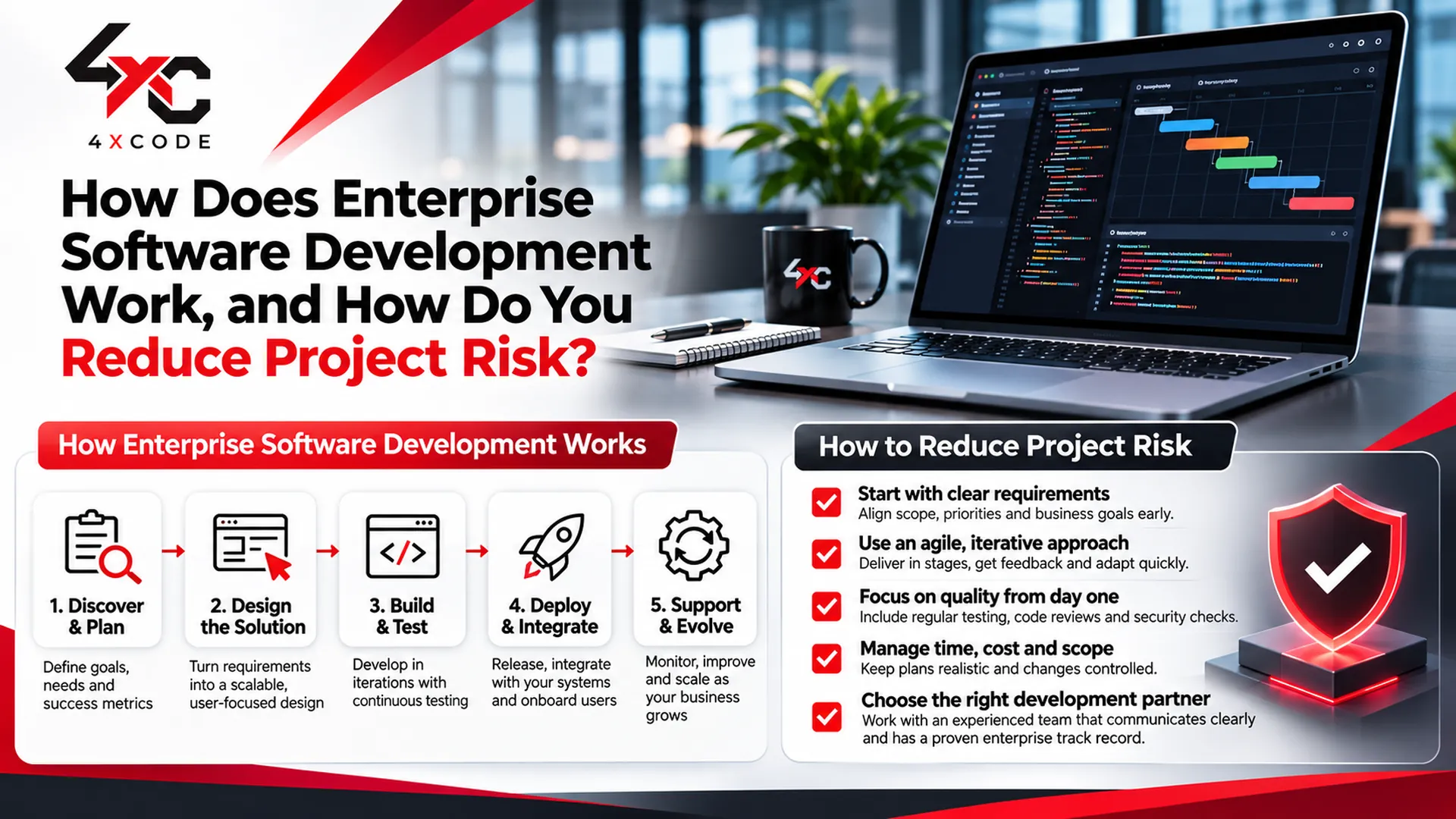
Most failed software projects do not fail because of bad code. They fail because of unclear scope, poor communication and decisions nobody wrote down. A good process exists to prevent exactly that.
What Are the Stages of Enterprise Software Development, From Discovery to Launch?
Every project is different, but the shape of a well-run engagement is consistent.
- Discovery and business requirements analysis. We listen first. We learn how your teams work, where the pain sits and what success would look like, then turn that into clear requirements.
- Software architecture and technical planning. We decide how the system will be structured, which technologies suit it and how it will scale, connect and stay secure.
- UI and UX design and prototyping. You see how the software will look and behave before development begins, so changes are cheap and early.
- Backend and frontend development. Working software is built in short, reviewable stages using agile software development.
- API and third-party integrations. The new system is connected to the tools and data sources your business already relies on.
- Quality assurance and software testing. Automated and manual testing check functionality, performance and security throughout, not just at the end.
- Deployment and implementation. The system is released in a controlled way, with cloud deployment and CI/CD pipelines where they suit the project.
- Ongoing maintenance and optimisation. After launch, we monitor, update and improve the software as your needs change.
Phased delivery is the heart of risk control. Instead of disappearing for months and returning with a finished product, we deliver in stages, so you see working software early and can steer before you commit further. That is also why prototypes matter: seeing it working before we build it removes most of the guesswork.
Why do enterprise projects stall? The usual reasons are:
- A vague scope that grows without anyone agreeing to it.
- No single owner on the client side to make decisions.
- Long silences between updates.
- Important choices made verbally and then forgotten.
We counter these with a clearly defined scope, regular communication, documented decisions and a transparent view of progress at every stage.
How Do You Handle Legacy Systems, Integrations, Security and Scalability?
These four topics decide whether a project succeeds, and they deserve straight answers.
Legacy modernisation and migration. Few businesses start from a blank page. Legacy software modernisation might mean refactoring existing code, re-platforming to a modern foundation or migrating to cloud-based infrastructure. Data migration is handled carefully, with testing and fall-back plans, so operations are disrupted as little as possible. Sometimes the right answer is to modernise in stages, replacing one part at a time instead of switching everything off on a single weekend.
Integration. Enterprise software never lives alone. We build API integration, using REST APIs and other standard approaches, to connect your ERP, CRM, finance tools and third-party systems so data flows in one direction and stays consistent. Good enterprise system integration means your teams stop retyping the same information into different screens.
Security and quality. Security is designed in from the start. That means role-based access control, encryption of sensitive data, secure coding practices, authentication controls such as multi-factor authentication where appropriate, and testing for vulnerabilities and performance under load. Automated testing helps catch problems early and keeps changes safe over time. We will always tell you exactly which practices apply to your project, and we do not claim certifications we cannot show you.
Architecture and scalability. We design scalable software architecture that suits the real size and shape of your business. For some projects that means a well-structured modular application. For others, microservices and cloud-native design make sense. The point is to choose what fits, not what is fashionable, because overengineering adds cost and complexity without adding value. Cloud platforms such as AWS, Microsoft Azure and Google Cloud, along with containerisation, can support scale and resilience where the project calls for them.
A typical scenario shows how this works in practice. A growing business runs orders in one system, stock in another and customer records in a third, with staff reconciling them by hand every week. Rather than replacing everything at once, a sensible approach is to build an integration layer first, give teams a single dashboard, then gradually move the most painful workflows into one custom platform. The business sees value in weeks, and the risk stays small.
Who Owns the Code, and Is Support Included After Launch?
Buyers should never have to guess about ownership and support, so we answer these questions at the start.
- Code and intellectual property. Our approach is that you own what we build for you. Ownership terms are written into the agreement so there is no ambiguity.
- Confidentiality. We are happy to sign a non-disclosure agreement before any detailed discussion, and we treat your business information as confidential throughout the project.
- Documentation and knowledge transfer. We document architecture, key decisions and how the system works, so your team, or another team, can understand it. You are never locked in.
- Post-launch support. Launch is the start of a system's life, not the end. Support covers monitoring, security updates, bug fixing, performance optimisation and continued improvement as your needs evolve.
Ask any agency the same four questions. A confident, specific answer is a good sign, and vagueness is a warning.
How Much Does Enterprise Software Development Cost, and How Do You Choose the Right Agency?
Cost is usually the first question and the hardest to answer in the abstract. The honest reply is that it depends on what you need, and any figure given without understanding your project is a guess. What we can do is show you what drives the cost, so you can judge any estimate you receive.
What Affects the Cost of Enterprise Software Development, and Which Engagement Model Fits?
Several factors shape the effort, and therefore the investment, behind enterprise software.
- Scope and complexity. The number of features, user roles, workflows and reports is the biggest driver.
- Integrations and data migration. Connecting to existing systems and moving legacy data takes careful work, and the more systems involved, the more effort required.
- Technology and infrastructure. Cloud architecture, performance needs and availability requirements all influence the design and the work.
- Team size and seniority. Experienced engineers and architects cost more per hour but often reach a better result faster, with fewer expensive mistakes.
- Security and compliance needs. Regulated data or strict access requirements add design and testing effort.
- Ongoing support and maintenance. The system needs care after launch, and that should be planned from the beginning.
Different projects suit different ways of working together. These are the common engagement models.
Model | How it works | Best for |
| Fixed scope | Clearly defined scope, timeline and deliverables agreed upfront | Well-understood projects with stable requirements |
| Time and materials | You pay for the effort used, with flexibility to adjust as you learn | Evolving products and projects where requirements will change |
| Dedicated team | A team works as an extension of your own, over a longer period | Ongoing product development and larger programmes |
We will recommend the model that matches your project, not the one that suits us best. A fair estimate should always include the scope, the assumptions behind it, key milestones, the team involved, the timeline and the support terms. If an estimate leaves any of those out, ask why.
We do not publish figures on this page because every project differs. Instead, we offer a free consultation and a clear, scoped estimate once we understand what you need.
How Do You Choose a Reliable Enterprise Software Development Partner?
Selecting an agency is a big decision, because you may work together for years. Here is what to look for.
- Relevant case studies and references that show real projects with real outcomes.
- Named technical leadership, so you know who is making the architecture decisions.
- A documented process that explains how discovery, delivery and communication work.
- Clear and regular communication, with a direct line to the people doing the work.
- A transparent estimate that explains what is included and what is not.
- Post-launch support that is described plainly and agreed in writing.
Before you sign with anyone, put these questions to them:
- Who exactly will work on my project, and how senior are they?
- How do you handle changes to scope once work has started?
- Who owns the code and the intellectual property?
- What happens after launch, and what does support include?
Watch for red flags too. A vague scope, no discovery phase, no references and pressure to commit before the problem has been properly understood are all reasons to pause. In-house hiring, freelancers, offshore teams and agencies each have a place, and the right choice depends on your size, budget and how much management you want to take on. A good agency will help you weigh that up honestly, even when the answer is not to hire an agency.
At 4xCode, we explain what we would build and why, show you how we would deliver it and put the important commitments in writing. Our aim is a long-term partnership you can rely on, not a one-off transaction.
Ready to discuss your enterprise software project? Book a free consultation, and we will help you understand your options, scope the work and plan the next step with confidence.
Enterprise Software Development Agency FAQs
What is enterprise software development?
It is the design, building, integration and maintenance of software that supports core business operations at scale. Examples include ERP, CRM, workflow systems, reporting platforms and customer portals.
What does an enterprise software development agency do?
It takes a business from requirements through architecture, design, development, testing, deployment and ongoing support. A good agency also advises on whether custom software is the right route at all.
How long does enterprise software development take?
It depends on scope, complexity and integrations. Smaller systems can be delivered in a matter of months, while large platforms take longer and are best delivered in phases. A discovery stage gives a realistic timeline for your project.
Is custom enterprise software worth the investment?
It is when your processes are unique, off-the-shelf tools force costly workarounds or the software is central to how you compete. If a standard product does the job well, buying may be the smarter choice.
What is the difference between enterprise software and regular software?
Enterprise software is built for organisations, with a focus on scale, security, integration, reliability and many users working with shared data. Regular software often serves individuals or simple, standalone tasks.
Should I outsource enterprise software development?
Outsourcing suits businesses that need specialist skills, faster delivery or flexible capacity without building a large in-house team. Choose a partner with clear communication, documented ownership terms and a transparent process.
Can you integrate with our existing systems?
Yes. Enterprise system integration is a core part of the work, using APIs and standard approaches to connect new software with your current tools and data.
How do you modernise legacy software?
We assess the existing system, then choose between refactoring, re-platforming or migration, often in stages, so operations continue while the new foundation is built.
How do you keep enterprise software secure?
Through secure design and coding, access control, encryption, authentication, testing and regular updates. The exact measures depend on your data and requirements.
What technologies do you use?
We choose technologies to suit the project, covering cloud platforms, modern web frameworks, databases and APIs. We will recommend a stack during planning based on what fits your needs, not what is trendy.
Who owns the code?
You do. Ownership and intellectual property terms are written into the agreement so there is no ambiguity.
Can you sign an NDA?
Yes. We are happy to sign a non-disclosure agreement before detailed discussions begin.
What happens after the software launches?
Launch is the start of the support phase. We monitor performance, apply updates, fix issues and continue improving the system as your business changes.
How do I choose an enterprise software development agency?
Look for relevant case studies, named technical leadership, a documented process, clear communication, a transparent estimate and written support terms. Ask who will work on your project and who owns the code.
Your next system should fit your business, not the other way round. The right enterprise software removes manual work, connects your data and gives your teams room to grow. The wrong choice, or a badly run project, does the opposite.
The 4xCode team can help you decide whether custom software is right for you, scope the work clearly and deliver it in stages you can see and steer. Book a free consultation today and start the conversation about your enterprise software project.