
Your team has outgrown its tools. Data sits in five different systems that refuse to talk to each other, spreadsheets hold together processes that should have been automated years ago, and every new licence fee seems to buy features you will never use. Or you have a product idea you believe in and no one you trust to build it.
That is usually the moment people start searching for custom software development companies. It is also the moment where a bad choice gets expensive, because software is hard to unpick once it is built on the wrong foundations.
This guide explains what custom software development companies actually do, when bespoke software beats ready-made tools, how the process works from discovery to launch and support, what drives cost, and how to choose a software development partner you can rely on. The right company is the one that understands your business first, explains its process and costs openly, and leaves you owning what it builds.
If you already know what you need, request a custom software development consultation with 4xcode.com and we will give you an honest view of the best way forward.
What Do Custom Software Development Companies Do, and Is Custom Software Better Than Off-the-Shelf?
A custom software development company designs, builds, tests, launches and maintains software made specifically for one organisation's needs. The software may be called custom, bespoke or tailored. The idea is the same: it fits your workflows, instead of forcing your workflows to fit the software.
Off-the-shelf products are built for the average customer. Custom software is built for you. Neither is always right, and a good partner will tell you which one your situation calls for.
What Services Do Custom Software Development Companies Offer, and When Does Bespoke Software Make More Sense Than Ready-Made Tools?
Most software development agencies and engineering firms cover a similar range of services. The exact mix varies by company, so always confirm what a provider genuinely delivers. Typical services include:
- Custom web application development: Browser-based business systems, customer portals and internal tools that run on any device.
- Custom mobile application development: Apps for iOS and Android, or cross-platform apps that serve both from one codebase.
- Enterprise software development: Larger, integrated systems built around complex operations, user roles and reporting needs.
- SaaS development services: Subscription software products, from minimum viable product to full platform.
- Custom CRM and ERP development: Customer and resource management systems shaped around how your business really works.
- API development and integration: Connecting your systems with each other and with third-party services so data flows without manual re-entry.
- Cloud application development: Scalable applications hosted on cloud infrastructure such as AWS, Microsoft Azure or Google Cloud.
- AI-powered software solutions: Machine learning and automation features added where they solve a real problem.
- Legacy software modernisation: Migrating or rebuilding ageing systems that are slow, insecure or impossible to maintain.
- Business process automation: Software that removes repetitive manual work and reduces human error.
How do you know whether you need custom software at all? These are the signs we see most often:
- Workarounds everywhere: Staff rely on spreadsheets, copy and paste, and manual exports to get work done.
- Systems that do not integrate: Information has to be entered twice, and reports never quite match.
- Growing licence costs: You pay per user for features you do not use, and the bill rises as you hire.
- Limited customisation: The product cannot do what your process requires, and the vendor will not change it.
- Scalability limits: Performance suffers as data and users grow.
- Security or compliance concerns: You need tighter control over where data lives and who can access it.
Here is how the two options compare.
Factor | Custom software | Off-the-shelf software |
| Fit to your process | Built around your requirements | Generic, with limited configuration |
| Flexibility | Features change as your business changes | Depends on the vendor's roadmap |
| Integration | Designed to connect with your existing systems | Often limited to supported connectors |
| Scalability | Architecture planned for your growth | May hit plan or performance limits |
| Ownership and control | You can own the code and data, depending on the agreement | Vendor owns the product, and you rent access |
| Upfront effort | Higher, because discovery and development come first | Lower, because you can start quickly |
| Long-term cost factors | Maintenance and enhancement, with no per-user licence growth | Recurring licences that rise with your headcount |
Here is the honest part. Off-the-shelf software is often the better choice when your needs are standard, your budget is tight or you need something running quickly. Payroll, basic accounting and generic email tools rarely justify a custom build. Custom software earns its place when the process is a genuine competitive advantage, when no product fits, or when the cost and limits of stitching tools together outweigh the cost of building something right.
Not sure which side of the line you are on? Tell us about your problem and we will give you an honest view.
How Does the Custom Software Development Process Work, From Discovery to Launch and Support?
Many projects go wrong before a single line of code is written. Unclear requirements, vague proposals and missing handovers cause far more damage than technical difficulty. A clear process protects you from all three.
What Are the Stages of Custom Software Development, and What Do You Get at Each Stage?
A well-run project moves through defined stages, each with something tangible you can review.
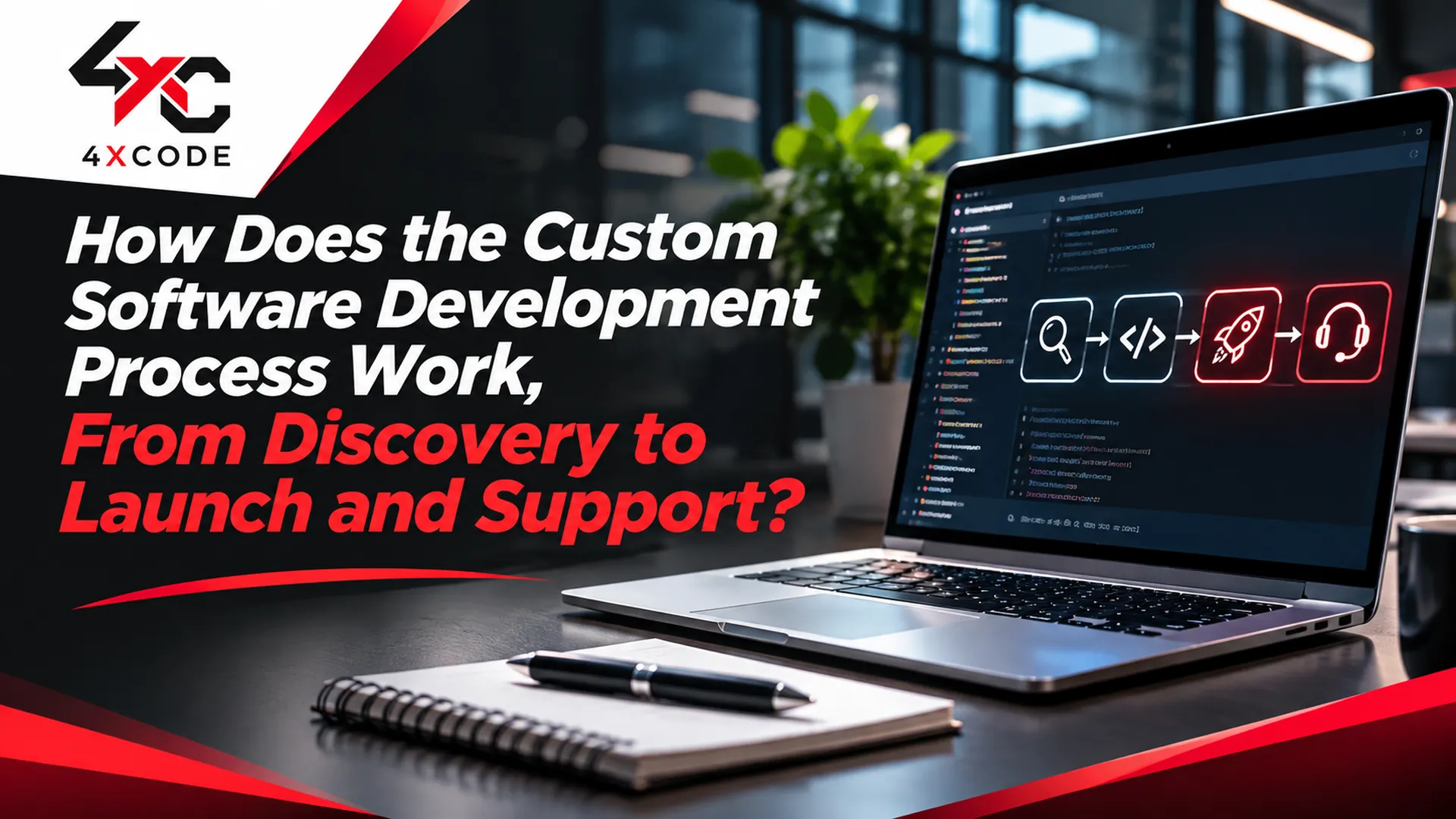
- Initial consultation and requirements gathering: We listen to the business problem, the people affected and the outcome you want. You receive a clear summary of the requirements as we understand them.
- Business analysis and product discovery: We look at your current workflows, data and systems, and identify risks and priorities. The deliverable is a scoped plan and a prioritised backlog.
- Software architecture and technical planning: We choose the architecture and technology stack that fit your needs, covering frontend, backend, database, hosting and integrations. You see the technical approach and the reasoning behind it.
- UI and UX design and prototyping: Wireframes and prototypes show how the software will look and behave before development starts, so changes are cheap and early.
- Development: Frontend and backend development, database design and API integration happen in short iterations. Version control, code review and technical documentation run alongside.
- Testing and quality assurance: Automated testing, regression testing and user acceptance testing catch problems before your users do. Performance and scalability checks follow where relevant.
- Deployment and launch: Continuous integration and a controlled release process move the software into production with minimal disruption.
- Maintenance and technical support: After launch, the software is monitored, updated and improved.
How do you stay informed along the way? Agile delivery, with regular sprint reviews, means you see working software at set intervals and can steer priorities as you go. You are never left wondering what the team has been doing for six weeks.
Security belongs in every stage, not just at the end. That includes sensible data encryption, authentication and access control, secure coding practices and attention to data protection requirements such as GDPR. The specific measures depend on the project and the data involved, and they should be discussed openly before work begins.
What Happens When Requirements Change, Who Owns the Source Code and What Support Follows Launch?
These three questions decide whether a project stays healthy long after launch. Ask them early.
What happens when requirements change? They will. Markets shift, users surprise you and priorities move. A good partner has an agreed way to handle change. New requests are assessed for their effect on scope, timeline and budget, and agreed before work starts. Surprises on an invoice are a warning sign.
Who owns the source code? This must be written into the agreement, not assumed. Look for clear terms on ownership of source code and intellectual property rights, access to the repository, technical documentation and a smooth handover if you ever change provider. A company that holds your code hostage is not a partner.
What support follows launch? Software needs care after release. Typical post-launch support includes:
- Bug fixing: Prompt correction of defects found in live use.
- Security updates: Patches and dependency updates that keep the application safe.
- Application monitoring: Watching performance, errors and uptime so problems are found early.
- Maintenance agreements: Clear, agreed terms for ongoing support and improvements.
- Continuous improvement: Planned enhancements as your business grows.
In our experience, most project delays trace back to unclear requirements, not to difficult code. A proper discovery stage prevents most of them, because it forces the hard questions to the surface while they are still cheap to answer.
Want to see how discovery works in practice? Book a discovery call.
How Much Does Custom Software Development Cost, and How Long Does It Take?

Every buyer asks about cost, and every honest provider gives the same first answer: it depends. A simple internal tool and a multi-user enterprise platform are entirely different projects. A company that quotes a single figure without understanding your requirements is guessing, and you will pay for the guess later.
What Factors Affect the Cost of Custom Software, and What Is the Difference Between Fixed-Price and Time-and-Materials Pricing?
Several factors shape the cost of custom software development:
- Complexity and project scope: More features, user roles and business rules mean more design, development and testing.
- Number of integrations: Each connection to an existing system or third-party service adds work.
- Technology stack: Some technologies and platforms demand more specialised skills than others.
- Design requirements: A polished, highly customised interface takes more design effort than a functional internal tool.
- Team size and experience: Senior engineers and larger teams cost more per hour but can reduce rework and risk.
- Security and compliance needs: Regulated data, audit trails and strict access control add effort.
- Ongoing maintenance: Hosting, monitoring, updates and support continue after launch.
Providers usually offer a few engagement models. This table shows how they compare.
Model | Best for | Flexibility | Risk | Budget control |
| Fixed price | Projects with clearly defined scope and requirements | Low, because changes need renegotiation | Lower cost risk for you, higher risk that scope disputes arise | Strong, if the scope is truly fixed |
| Time and materials | Evolving products and projects where requirements will shift | High, because priorities can change sprint by sprint | Cost can grow without active management | Good, with regular reporting and budget caps |
| Dedicated team | Long-term product development and ongoing work | High, because the team works as an extension of yours | Depends on management and clear goals | Predictable monthly commitment |
What about timelines? They depend on scope, complexity and how quickly decisions are made on your side. A focused minimum viable product takes a very different amount of time from a full enterprise platform with legacy migration. We do not promise a duration before discovery, because any number given before then is a guess.
A good estimate follows a clear pattern. Discovery comes first. Then you receive an itemised proposal that lists what is included, what is not, the assumptions behind the numbers and how changes will be handled. That gives you something concrete to compare against other quotes.
And remember that the lowest quote is not always the best value. A cheap estimate that skips discovery, ignores testing or leaves out documentation often turns into the most expensive option once rework, delays and technical debt appear. Judge a proposal on clarity, completeness and the quality of the thinking behind it.
Ready to see where your project stands? Request a software development estimate.
How Do I Choose the Right Custom Software Development Company, and How Do I Get Started?
Choosing a partner is the most consequential decision in the whole project. The list below gives you a practical way to judge any provider, including us.
What Should I Look For in a Software Development Partner, and What Questions Should I Ask Before Hiring?
Use this checklist when you compare companies:
- Relevant case studies and portfolio: Look for real projects similar to yours, with outcomes described honestly.
- Technical expertise: The team should explain why they recommend a given architecture or stack, not just name technologies.
- Industry experience: Familiarity with your sector shortens discovery and reduces mistakes.
- Project management and communication: Expect a named point of contact, regular updates and visible progress.
- Security and intellectual property terms: Data handling and code ownership should be clear in writing.
- Pricing transparency: Proposals should be itemised, with assumptions stated.
- Post-launch support: Maintenance and improvement should be part of the conversation from day one.
These questions separate serious providers from the rest. Ask every company on your shortlist:
- Who will actually work on my project? You should know the people, their roles and their experience.
- How will I see progress before I pay an invoice? Look for demos, sprint reviews and access to working builds.
- Who owns the source code and intellectual property? The answer should be unambiguous.
- What happens if my requirements change? There should be a defined change process.
- What support follows launch? Ask what is included and how it is priced.
- How do you protect my data? Expect specifics on access control, encryption and testing.
- Can you integrate with the systems I already use? Ask for examples of similar integrations.
Watch out for red flags too:
- Vague proposals: If you cannot tell what you would receive, neither can they.
- No discovery stage: Jumping straight to development is how scope and budgets spiral.
- Unclear ownership: Any hesitation on code and IP rights is a reason to walk away.
- No named team: You deserve to know who is building your software.
- Pressure to sign quickly: A good partner is happy for you to compare options.
Should you hire a software company, freelancers or an in-house team? Freelancers can suit small, well-defined tasks. An in-house team makes sense when software is your core product and you can sustain the hiring and management. A development company suits projects that need a full range of skills, from design and engineering to testing and support, without building a team from scratch.
At 4xcode.com, we work as a long-term technology partner, not a one-off supplier. We start with your business problem, agree scope and assumptions in writing, deliver in short, reviewable iterations and stay available after launch. We explain our reasoning, and we tell you when a simpler or cheaper route would serve you better.
Getting started is simple:
- Submit your requirements: Tell us what you need, even if it is only a rough idea.
- Discovery call: We ask questions, explore your goals and identify risks.
- Proposal and estimate: You receive an itemised plan with clear assumptions.
- Project kick-off: We agree the team, the schedule and the way we will communicate, then begin.
Ready to take the first step? Request your custom software development consultation today.
Frequently Asked Questions About Custom Software Development Companies
What does a custom software development company do?
It plans, designs, builds, tests, launches and maintains software made for one organisation's needs. That can include web and mobile applications, enterprise systems, SaaS products, integrations and automation tools.
What is the difference between custom and off-the-shelf software?
Custom software is built around your processes and can be changed as you grow. Off-the-shelf software is built for a general audience and offers limited customisation, though it is quicker to start with.
How much does custom software development cost?
It depends on complexity, scope, integrations, design, team size, security requirements and ongoing maintenance. A reliable estimate comes after discovery, as an itemised proposal with clear assumptions.
How long does it take to build custom software?
Timelines depend on scope and complexity. A focused minimum viable product takes a different amount of time from a large enterprise platform. We confirm realistic timeframes once discovery is complete.
How do I choose the best custom software development company?
Check relevant case studies, technical expertise, communication, security practice, pricing transparency, code ownership terms and post-launch support. Speak to the people who would actually work on your project.
What questions should I ask before hiring a software development company?
Ask who will work on your project, how you will see progress, who owns the source code, how changes are handled, what support follows launch and how your data is protected.
Who owns the source code after development?
That should be agreed in writing before work begins. Look for clear terms on source code, intellectual property rights, documentation and handover.
Can custom software integrate with my existing systems?
Usually, yes. Through APIs and third-party integrations, custom software can connect with CRM, ERP, accounting, payment and other existing systems. Complexity depends on what those systems support.
How do you keep my data and software secure?
Security is built into every stage, including secure coding, encryption, authentication, access control, testing and regular updates. Specific measures depend on your project and data.
What support do I get after launch?
Typical support covers bug fixing, security updates, monitoring, maintenance and planned improvements, under an agreed maintenance arrangement.
Should I hire a software company, freelancers or an in-house team?
Freelancers suit small, clearly defined tasks. An in-house team suits long-term, core product development. A software company suits projects that need design, engineering, testing and support together.
What happens if my requirements change during development?
Changes go through an agreed process. We assess the effect on scope, timeline and budget, and you approve it before the work starts.
Can custom software scale as my business grows?
It can, if scalability is planned from the architecture stage. We design with future users, data volumes and features in mind.
Is custom software worth the investment?
It is when your process is a genuine advantage, when no product fits, or when the cost and limits of combining several tools outweigh the cost of building the right one. A discovery conversation will tell you honestly.
Final Thoughts
Choosing among custom software development companies is less about who promises the most and more about who explains the most. A strong partner understands your business before proposing a solution, shows you a clear process, gives you an estimate you can examine, agrees who owns what in writing and stays with you after launch.
Look for transparency over polish. Ask the hard questions about ownership, change, support and security, and notice how each company answers. The answers tell you more than any portfolio page.
If your current tools are holding your business back, speak to 4xcode.com. We will listen to the problem, explain your options honestly and give you a clear, itemised proposal. Request your custom software development consultation today and start building software that fits the way you work.